


The RFQ that went
to three other shops
By Chris Bender — 2026-08-04 · Manufacturing & machining

A buyer at a mid-size OEM has a drawing and a deadline. At 10:40 on a Tuesday they email the same PDF to three shops, with a subject line that says RFQ and a body that says "can you quote this, need it by the 12th."
One shop replies at 10:52. Not with a price — just: received, we have it, Dave is looking at it, you will have a number Thursday.
One replies Wednesday afternoon with a price.
One replies Friday.
All three quotes might land within a few dollars of each other. Only one of those shops was in the conversation while the buyer was still deciding who to have a conversation with.
Where the RFQ actually goes
Two things are happening there, and only one of them is about the quote.
The first is acknowledgement. A buyer who sends three RFQs is managing risk. They want to know the work will land somewhere that answers the phone in November. Two days of silence reads as capacity trouble or disinterest, whether or not either is true. The shop that said "received, Thursday" bought a position that had nothing to do with price and cost it twelve seconds.
The second is slower, and it is the one that costs an established shop the most: a good many RFQs never arrive at all.
A buyer with a new part and no incumbent supplier is not handed a list. They search. CNC machining Waterloo. Wire EDM Ontario. Five-axis job shop near me. If the shop that has been cutting steel since 1985 has a site from 2011, a Google Business Profile with the wrong hours, and nothing anywhere that names the machines, the envelopes or the tolerances it can hold, it is not in the running. Not because it lost the quote. Because it was never a candidate.
That is the uncomfortable part of this one. The shop that got the RFQ instead may be a worse shop with a better page.
What gets installed
- A site that tells a buyer what you can actually hold. Machine list, work envelopes, tolerances, materials, certifications, typical lot sizes, lead times you are willing to state in public. A buyer is trying to disqualify shops quickly, and specifics are what stop them disqualifying yours. "Quality is our passion" tells them nothing and reads as a shop that does not want to commit.
- A quote form that starts a conversation, not an email you miss. The RFQ arrives with the fields an estimator needs filled in, and it opens a thread rather than dropping a PDF into a mailbox that four people half-watch.
- An acknowledgement on every RFQ, immediately. In your wording, confirming receipt and setting a time. This is the twelve seconds from the story, made automatic.
- Local search treated as maintenance rather than a project. On-site, off-site and technical work, plus the Google Business Profile, with a written report every month. Local search is a maintenance job, not a project. Profiles drift, competitors add pages, and Google changes what it wants, so the work is continuous or it decays.
That last one is worth being blunt about: anyone selling a machine shop a one-time search fix is selling something with an expiry date on it.
What you approve before anything runs
The acknowledgement text, first, and this matters more in machining than in any other trade on this site. An automatic acknowledgement here has exactly one job: confirm receipt and set a time. It does not quote. It does not confirm capability. It does not commit to a delivery date. Those are estimator decisions made by a person looking at a drawing, and no automation of ours is permitted anywhere near them.
You also approve:
- which enquiries escalate to a human immediately — a named account or a repeat customer should never sit in a queue
- the hours, the stop conditions, and opt-out handling
- everything that goes on the public site
That last point is not boilerplate. Nothing about a customer's part goes on your website without your say-so. Photographs of work on the floor get cleared by you, named customers get cleared by them, and drawings do not go up at all. A shop that has held forty years of confidentiality does not get to lose it to a marketing page.
“Local search is a maintenance job,
Chris Bender
not a project.”
What this does not promise
We sell the mechanism, not the market.
We do not promise rankings, traffic, a position on any search results page, or a date by which any of that arrives. We do not promise that an RFQ turns into a purchase order. What a buyer does after they get your number depends on your price, your lead time, your capacity that month, and what the other two shops quoted. None of that belongs to us, so none of it goes in your agreement.
What does belong to us is narrower. Every RFQ gets acknowledged in your words within seconds of arriving. The site states what you can hold, in the terms a buyer searches with. The profile, the on-site work and the technical work get maintained every month, and you get a written report saying what changed — a report you actually receive, not a dashboard login you never open.
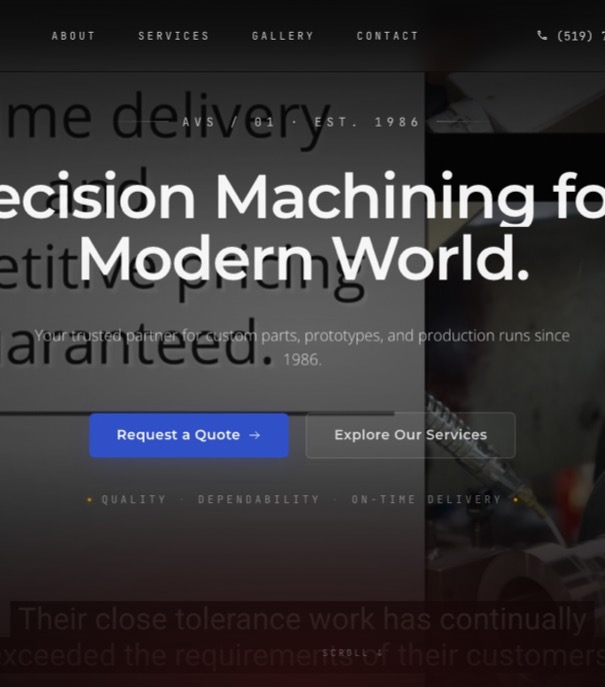
That is what the AVS Machine and Tool build is. A forty-year-old family machine shop with modern inbound, built to win work alongside shops that have full-time marketing teams.
Where this sits in the product line
Each part of the mechanism above is a product with a page of its own, and each one states what it does and what it needs from you.
- Functional Websites — Built and hosted in the plan
- Local SEO — On-site, off-site and technical
- Automated Lead Follow-Up — Forms, chat, calls and DMs
Automatq guarantees the agreed launch remedy — not lead volume, customer behaviour, booked jobs, closed revenue, or return on investment.