


Résumé piles on one side.
Unfilled roles on the other.
By Chris Bender — 2026-08-11 · Staffing & recruiting

An application arrives at 11:40 on a Wednesday night. The candidate is a CNC operator with four years on Mazak, and they applied from a phone, on a job board, from the couch. They also applied to two other agencies inside the same twenty minutes, because that is what job boards are for.
You see it at 8:15 the next morning, somewhere between an employer asking where Thursday's shift cover is and a résumé that landed in the shared inbox with no subject line and a file called CV_final_2.docx.
You reply that afternoon. The operator already has a phone screen booked with somebody else.
Staffing is the only business here where the lead arrives from both directions at once, and where being second is much the same as being absent.
Where the lead actually goes
Two pipelines, one inbox. Candidates on one side, employer roles on the other, both arriving as email, neither labelled.
The candidate side leaks on speed. A candidate who hears nothing is not deciding — they are already somewhere else. Nobody consciously rejects an agency that did not reply. The agency simply stops existing for them, and it happens inside a day.
The employer side leaks differently, and more expensively. An employer enquiry arrives far less often, matters a great deal more, and looks exactly like every other unread line in the list. It gets buried under forty applications for a role that closed last week. Nobody misses it on purpose. It just had the same visual weight as everything else in a mailbox that treats a new client the same as a newsletter.
Then there is the sorting problem underneath both. Somebody has to open every attachment, work out whether this operator has actually run the machines the role calls for, and move them somewhere useful. That is a person doing pattern-matching for two hours a day inside a tool designed for correspondence, and it is the first thing to slide on a busy week.
What gets installed
- One thread list instead of four apps. Email, text, Facebook and Instagram arrive in one place, in one order, with the employer conversations visible as employer conversations. Four apps means four places to forget, and whichever one you did not open that day is where the enquiry dies.
- An acknowledgement that does not wait for morning. Every application and every employer enquiry gets a reply immediately, in wording you approved. The two paths say different things, because a candidate and a hiring manager are not owed the same message.
- Screening that happens before you open anything. Applications are read against the requirements of the role they came in for, and arrive as a shortlist rather than a pile. The point is not that a machine decides — it is that the two hours of sorting are already done when you sit down, and you spend your attention on the five that are worth it.
- A site that does the intake properly. A job board candidates can apply through, and an employer path that captures the role the first time: shift pattern, certifications, start date, rate. Rather than a contact form that produces "we need 3 welders" and a phone number, and a callback that has to establish everything from scratch.
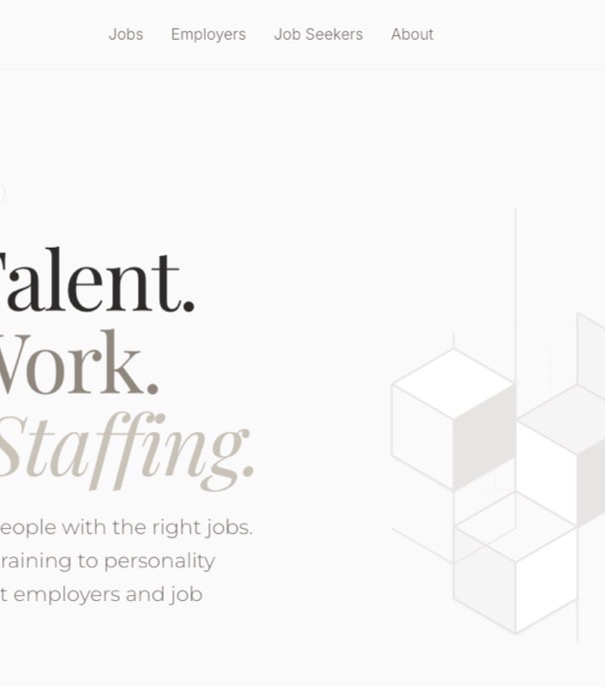
That is what the Acme Staffing build is: a staffing agency that wakes up to filtered candidates instead of résumé piles, wired into one workflow that runs without a human juggling six tabs.
What you approve before anything runs
Two scripts, not one. The candidate acknowledgement and the employer acknowledgement are written separately, and you sign off on both.
You also approve:
- the screening criteria for each role, and what disqualifies an application outright
- what escalates to a human immediately — an employer enquiry always should
- the hours, the stop conditions, and opt-out handling
- what never gets automated at all
That last one deserves a sentence of its own. Rejections do not go out on a machine's judgement here unless you have decided the wording and the threshold yourself, because a candidate you turn down this month is a candidate you place next month, and the message they remember is the one that told them no. Offers are the same. The automation does intake, acknowledgement and sorting. Decisions stay with you.
Consent handling follows CASL, and an opt-out ends the thread and is recorded.
“A candidate who hears nothing is not deciding.
Chris Bender
They are already somewhere else.”
What this does not promise
We sell the mechanism, not the market.
We do not promise time-to-fill, fill rates, or that a given role gets filled at all. Whether a machinist takes a contract in Guelph depends on the rate, the shift, the commute, and what three other agencies offered them the same week. None of that is ours to control, so none of it goes in your agreement. We do not forecast application counts either.
What is ours is narrower. Every application and every employer enquiry gets acknowledged, in wording you approved, without waiting for somebody to open the inbox. Applications arrive sorted against criteria you set. Both sides live in one thread list instead of four. That is the machine, and it is what gets built, operated and put in writing.
The full staffing platform — job board, employer onboarding, candidate intake, the back-office admin and the agent stack behind it — is a managed engagement rather than a plan you pick off a page. It starts with a conversation about your roles and your existing system, whether that is Bullhorn, Vincere, or a shared inbox and a spreadsheet.
Where this sits in the product line
Each part of the mechanism above is a product with a page of its own, and each one states what it does and what it needs from you.
- All-In-One Inbox — Four channels in one thread list
- Automated Lead Follow-Up — Forms, chat, calls and DMs
- Functional Websites — Built and hosted in the plan
Automatq guarantees the agreed launch remedy — not lead volume, customer behaviour, booked jobs, closed revenue, or return on investment.